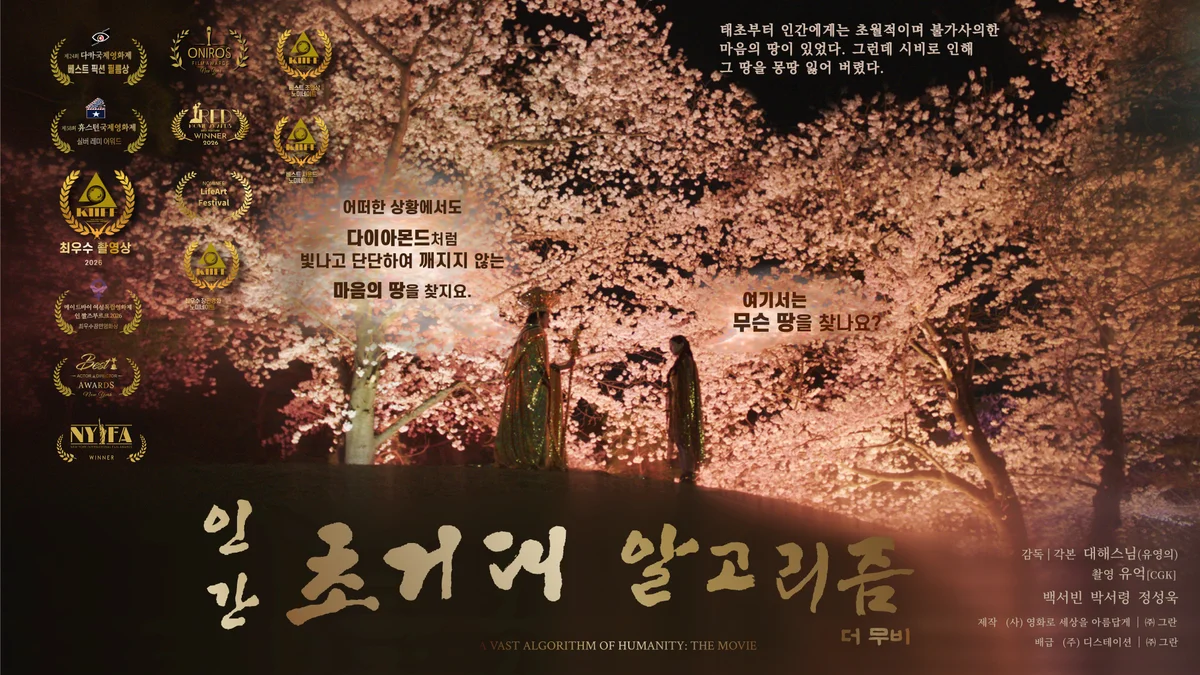
A film directed by a Buddhist nun opened in Korean theaters on November 25, asking what remains human in an age when algorithms make our decisions for us. “Human Super-Giant Algorithm: The Movie,” directed by Ven. Daehye, opened nationwide at CGV, bringing a philosophical courtroom drama to the big screen after a run of awards at international film festivals.
The film follows Doa, played by Park Seo-ryeong, a woman drawn into an inheritance lawsuit over land left behind by her husband’s grandfather. As the dispute drags on, she begins communicating with the “Beopwangja,” an inner principle the film presents as a law living inside every person, and her search for a way through the case becomes a search for the “great land” within herself. The story deliberately steps away from the usual courtroom-drama formula, where a verdict divides winners from losers under the written law. Instead, it looks for a resolution grounded in what the film calls natural law, the idea that human beings carry an inner order that can settle conflict without anyone being defeated.
Daehye, whose secular name is Yoo Young-ui, has directed more than 120 films since 2007, according to Korean press coverage of the opening. “Human Super-Giant Algorithm” is her second feature, following “Sermon on the Mount,” which collected 22 awards at international film festivals and was screened at United Nations headquarters in New York. The new film continues the questions she raised in that earlier work, this time translating them into the language of the artificial intelligence era: if algorithms now stand in for human judgment, what ability do human beings still carry that no machine can replace?
The cast around Park Seo-ryeong includes Baek Seo-bin as Bonghwang, a shopkeeper who has run a store on the disputed land for years, and Jung Sung-wook as the husband’s half-uncle, whose claim to the property drives the family conflict. The film runs 128 minutes and is rated for viewers aged 12 and over. It held a preview screening at the National Assembly on November 24, the day before its theatrical opening.
The film has already collected awards at international festivals, including the Silver Remi Award at the 58th Houston International Film Festival and the Best Fiction Film award at the 24th Dhaka International Film Festival. That festival recognition gave the small independent production an unusual profile for a film opening on a major chain, and it arrived in theaters with its reputation already established overseas.
The production itself took an unusual path. The film was shot entirely on location, with no sets built at all, moving between the temples of Tongdosa, including the Seounam hermitage that houses 160,000 ceramic Tripitaka tablets, Buseoksa, and Unmunsa, and real courtrooms. Locations across North Gyeongsang Province, including Donggung and Wolji in Gyeongju, also feature in the film. Cinematographer Yoo Eok, known for “New World” and “The Match,” shot the film, and the production used an inverted-frame editing technique, flipping the image upside down to express an inner world where the boundaries between right and wrong, or above and below, no longer apply.
At the heart of the film is a system Daehye has described as 108 laws, or types, of human nature, a framework she says can help audiences recognize the strength already inside them and learn to use it. The title itself is a provocation: the “super-giant algorithm” is not a machine at all, but the transcendent ability she believes human beings are born with, expressed in the modern language of algorithms. The film poses a single question to its audience, in the director’s own framing: how will you use your own mind?
“Human Super-Giant Algorithm: The Movie” is now playing in CGV theaters across Korea.