The Korea Popular Music Industry Association has unveiled three guiding principles for AI music policy, calling for prior consent before music is used to train commercial AI, stronger protection of artists’ publicity rights, and fair rules for how AI-made songs are distributed and paid for.
The association, known as Daeumhyeop, announced the principles on November 24, along with the results of a survey of its AI working group. Of the 20 member companies in the working group, 14 responded to the survey conducted in September. Those 14 companies accounted for 83.4 percent of annual album sales on the Circle Chart’s top 100 for 2025, including affiliated labels. The membership includes the four major entertainment companies HYBE, SM Entertainment, JYP Entertainment and YG Entertainment, as well as Kakao Entertainment and the Korean subsidiaries of the three global majors, Universal Music, Sony Music and Warner Music.
The first principle is responsible AI training. The association’s position is that anyone seeking to use music for commercial AI training must obtain prior consent from rights holders, with payment agreed in advance. None of the 14 responding companies said they would support introducing an unconditional text and data mining exemption, which would excuse the large-scale collection and analysis of works for AI training from copyright liability. Nor did any respondent say it would actively take part in a “use first, compensate later” model that allows music to be used before rights holders are paid.
The second principle is artist rights protection. All 14 responding companies said stronger publicity rights protection is needed. Publicity rights bar the unauthorized commercial use of a well-known person’s name, image or voice, and the association is seeking legal protection and remedies to block AI cloning of faces and voices without an artist’s consent. It also called for action against AI content that harms an artist’s image or deceives listeners.
The third principle is fair distribution and settlement. The association urged a clear distinction between AI-generated music, which is produced entirely by AI, and AI-assisted music, in which a creator uses AI partly as a tool. For fully generated songs, it called for reasonable standards on disclosing AI use and preventing deceptive distribution. It also argued for fair settlement standards so that the mass supply of AI songs and fraudulent streams do not unfairly shrink the settlement share of existing rights holders. Nine of the 14 respondents, or 64 percent, said they already address AI use at the contract stage.
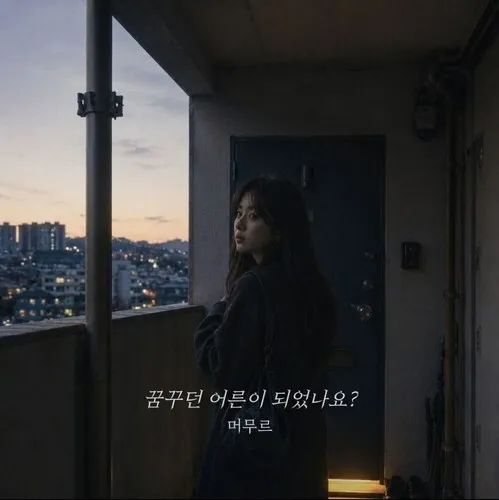
The announcement comes as AI music has moved from a hypothetical debate to the top of Korea’s biggest chart. “Kkumkkudeun Eoreuni Doeeonnayo?” (“Did You Become the Adult You Dreamed Of?”), a track by the music project MEOMURU, climbed to No. 1 on the Melon Top 100 on November 13, becoming the first AI-assisted song to top the chart. The song was released on June 23 and took roughly five months to reach the summit, rising through use as background music in short videos on Korean social media. Its creators, producers Lee Yong-seok and Choi Seong-hyeok, wrote the concept and lyrics and handled overall production, while the vocals were generated using Suno, a generative AI music tool.
The chart success has exposed a gap in the rules. The song has not been registered with a copyright trust, meaning its creators receive no royalties for composition, lyrics or arrangement even as it holds the No. 1 spot. The Korea Music Copyright Association, which manages the trust rights of lyricists and composers, is set to hold a public hearing on standards for registering AI-assisted music at the Conrad Seoul hotel in Yeouido. The association previously introduced registration rules for AI-assisted works in August, only to drop them after 22 days, leaving creators who disclose their AI use with no settled route to collect songwriting royalties.
Daeumhyeop said it plans to draw up a detailed policy agreement through its member working group within the year, and to push ahead with consultations involving the government, the National Assembly and music rights groups. The three principles are guidelines rather than law, but with the backing of companies behind more than four-fifths of Korea’s top-selling albums, they set the industry’s opening position for the rules that will follow.