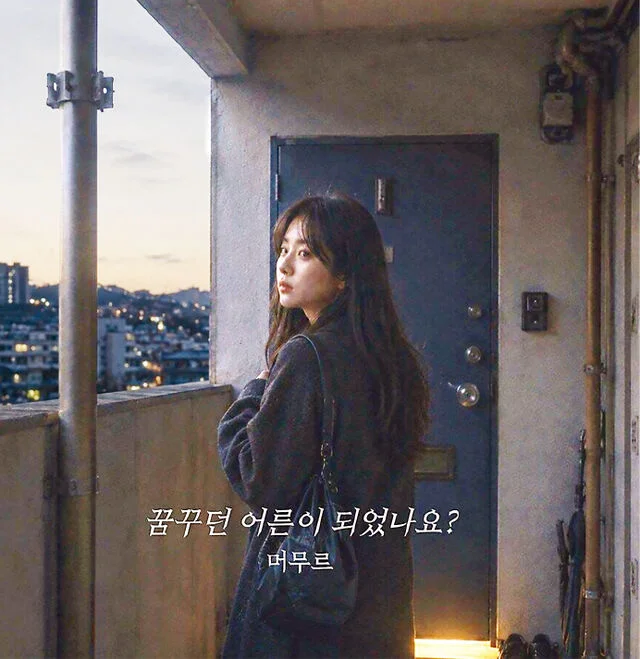
An AI-assisted song has done what no AI-made track had done before: top South Korea’s biggest music chart. “The Adult I Dreamed Of” by AI music project MEOMURU reached No. 1 on Melon’s TOP100 on the afternoon of November 13, becoming the first song created with AI to lead the chart — and it was still holding the top spot as of November 24, more than a week after first claiming it.
The song’s rise was slow and steady. Released on June 23, it spread through social media as background music for short-form videos, climbing the charts over about five months. It topped YouTube’s domestic daily popular music video chart in September, entered Melon’s TOP100 at No. 18 in early October, rose to No. 3 on November 6, and finally claimed No. 1 a week later. Its run at the top has come against strong competition from new girl-group releases, including RESCENE’s “With,” A2O LITE’s “Neon” and ILLIT’s “You’re Under Arrest” — all of which were trailing the AI-assisted ballad as of November 24.
The track itself is a rock ballad about the gap between the adult life people imagined as children and the reality they meet after growing up. Its human-written lyrics have struck a chord with listeners in their 30s and 40s in particular, while its soothing vocal has helped it travel beyond short-form videos and hold a place on the mainstream charts.
MEOMURU is the AI music project of Glorywave, a producing team made up of composers Lee Yong-seok, also known as Martin East, and Choi Seong-hyuk, known as Beatjaru. Both have previously worked on songs for artists including Hwang Chi-yeul and Gilgu Bonggu. The duo used the generative AI platform Suno to create the vocals, as well as to draft the melody and arrangement, while the humans handled the planning, the lyrics, the overall direction and the editing. The album description disclosed that the vocals were generated with Suno, though it does not spell out how far the AI’s involvement goes.
“What matters to listeners is not whether a song was made with AI, but the quality of the music itself and whether they can relate to it,” popular culture critic Kim Heon-sik said, in comments carried by Kookmin Ilbo. Another critic, Ha Jae-geun, cautioned that the industry is still in a transitional phase, saying AI has not yet reached the stage of producing hit songs on its own — but that as AI takes on more arranging, chorus and background-music work, young creators and support staff could see their jobs shrink.
Not everyone is celebrating the milestone. Music critic Park Hee-a said the significance of an AI-generated song reaching No. 1 lies in the fact that “the public can no longer distinguish AI-generated music from music made directly by humans,” adding that detection will only get harder as the technology improves and that more specialized AI music detection technology is needed.
AI has touched Korean music before, but never at this scale. In 2023, The Beatles used AI technology to separate John Lennon’s voice from an unreleased demo for “Now and Then,” their first new song in 27 years. In Korea, the 1990s duo Deux recently released a full album — their first in 31 years — built around new songs using an AI recreation of the late Kim Sung-jae’s voice. And in September, creator Joseon Hiphop’s AI-assisted track “Forest of the Heart” became the first AI-generated song to enter Melon’s TOP100, while overseas, Ingarose’s Suno-composed “Celebrate Me” rode TikTok popularity to No. 1 on iTunes charts in several countries. MEOMURU is the first to go all the way to the top of Melon.
The chart success has also exposed how far the industry’s rules lag behind the technology. Despite reaching No. 1, “The Adult I Dreamed Of” has not been registered with the Korea Music Copyright Association (KOMCA) for copyright trust management, so it does not receive copyright royalties through the association. Under the current Copyright Act, only elements involving human creative contributions are eligible for copyright protection. KOMCA set out criteria in August for registering AI-assisted music with human creative input, then withdrew them, citing the need for further public discussion. On November 24, the Korea Popular Music Industry Association unveiled three guiding principles for AI music policy, calling for prior consent before music is used to train commercial AI, stronger protection of artists’ publicity rights, and fair rules for distribution and payment.
Whether MEOMURU’s run is a one-off or the start of AI music’s mainstream arrival remains to be seen. What is already clear is that a song with no human singer has now topped Korea’s biggest chart — and the rules for who owns, labels and gets paid for that music have not caught up.