
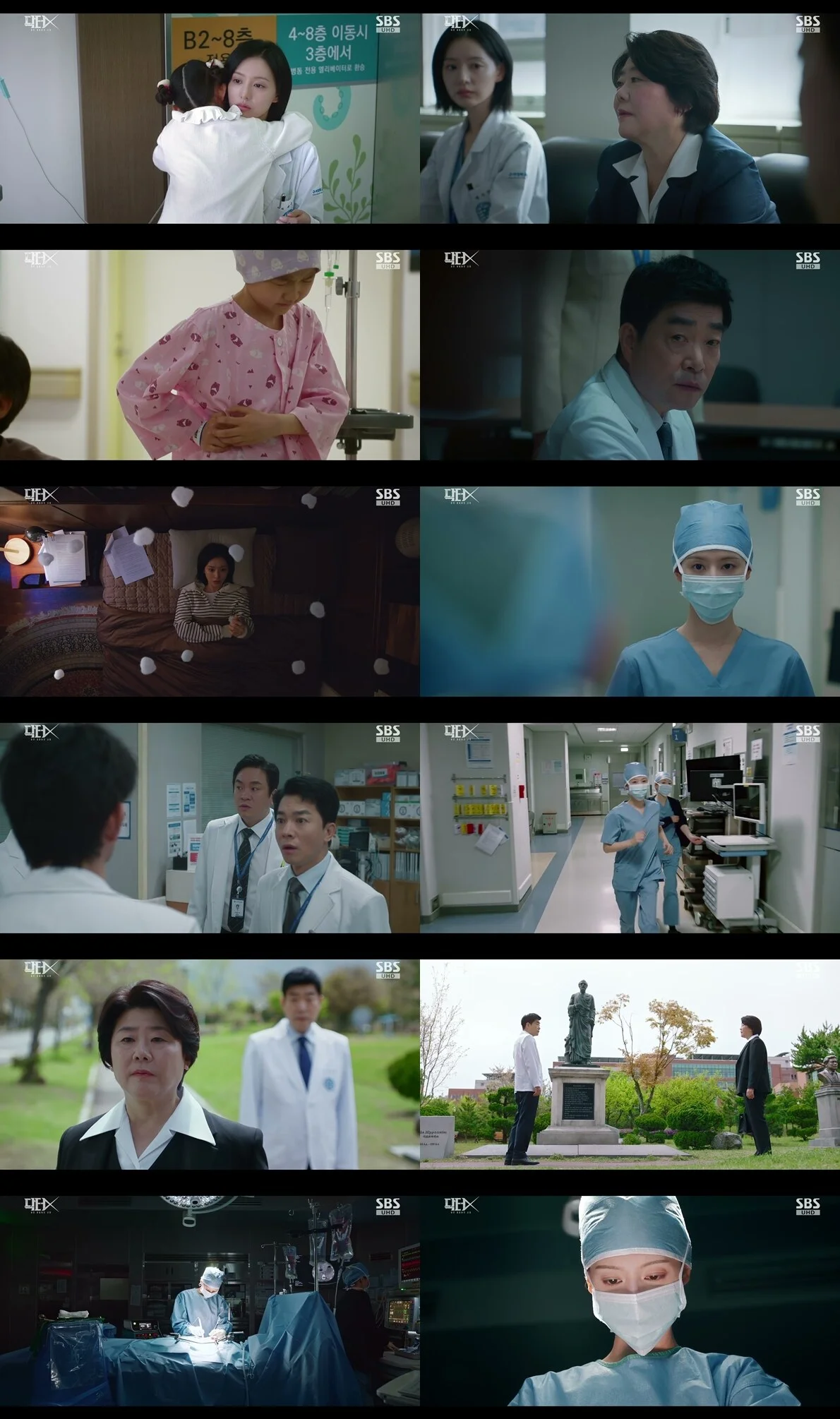
SBS’s medical drama “Doctor X: The Age of the White Mafia” slipped for a second consecutive episode on October 31, yet still finished the night on top. According to Nielsen Korea figures reported by SpotvNews and StarNews Korea, episode 8 recorded a nationwide rating of 15.6 percent, with a peak of 16.7 percent and a Seoul metropolitan area rating of 15.1 percent.
The result extends a downward turn that began the previous night. The series opened at 11.4 percent nationwide and climbed to a high of 19.5 percent for episode 6, before falling to 16.5 percent for episode 7 on October 30. Episode 8 then dropped a further 0.9 percentage points, marking two straight declines from the show’s peak.
Context matters here, because the decline has not cost the drama its lead. SpotvNews reported that “Doctor X” has now ranked first in its time slot for four consecutive weeks and first among all Saturday mini-series. StarNews Korea added a younger-skewing detail: the 2049 demographic rating peaked at 6.09 percent and averaged 5.4 percent, also ranking first in its time slot, among weekly mini-series, and among all Saturday programs. In other words, the show is losing some of its broad household audience while holding its core younger audience and its slot leadership.
Episode 8 leaned directly into one of the most sensitive issues in Korean medicine. The story centred on a doctors’ strike by resident physicians and the resulting medical vacuum, with surgeon Gye Su-jung, played by Kim Ji-won, working to fill the gap at Guseo University Hospital. That theme had been previewed ahead of broadcast, with reports noting that the episode would depict resident doctors staging a general strike in opposition to the expansion of medical school enrollment. The drama has repeatedly chosen real-world medical flashpoints as its subject matter, which helps explain both its ratings strength and the scrutiny it attracts.
Within that larger story, the episode’s emotional centre was paediatric care. Emergency medicine professor Kim Sung-jin asked Gye Su-jung’s team for a special favour: to operate on the teddy bear of eight-year-old cancer patient Lee Hyun-ah. The staged operation brought a moment of warmth, but the episode then made clear how fragile Lee Hyun-ah’s condition was, with surgery itself described as difficult because of her deteriorating health. A second young patient, ten-year-old Yoo Ga-eul, had undergone eight rounds of chemotherapy without improvement, and her surgery had been delayed indefinitely amid the hospital’s medical vacuum.
That case pushed Gye Su-jung to a dramatic declaration. Citing a contract clause that allowed her to perform the surgeries she wanted, she announced she would operate alone, without an assistant. Colleagues objected on safety and procedural grounds, but she argued that a doctor’s duty was to operate when a child’s life was at stake. Hospital director Bu Seung-kwon, played by Son Hyun-joo, then set a stark condition: a procedure that would normally take more than ten hours would have to be completed within six. The episode thus tied its ratings story to a familiar “Doctor X” formula, a brilliant but rule-breaking surgeon forcing an institution to bend around a single patient’s needs.
The background to the series helps explain why these episodes land so loudly. “Doctor X” is a medical noir built around Gye Su-jung, a surgeon described in Korean coverage as the operating room’s “crazy genius.” Directed by Lee Jung-rim and written by Pyun Seong-geun, it airs on SBS every Friday and Saturday at 9:50 p.m. Earlier in its run, the drama also tackled the May 18 democratization movement, depicting a patient who had suffered convulsions and hearing loss for 46 years after being shot in the head during the military crackdown in Gwangju in May 1980. That willingness to stage recent and painful history alongside present-day medical politics is a large part of the show’s identity, and a reason its ratings are watched as a cultural barometer as well as a commercial one.
No official statement was available from SBS about the ratings dip itself, and neither Korean report framed the decline as a crisis for the show. The numbers still leave “Doctor X” well above the level at which it started, and comfortably ahead of its Saturday competition. The question for the coming weeks is whether the second half of the run can stabilise around the mid-teens or climb back toward the 19.5 percent peak, or whether the politically charged subject matter continues to narrow its audience even as it holds the time slot. Episode 9 is scheduled for November 6, and its rating will be the first test of whether episode 8 was a plateau or the start of a longer slide.