
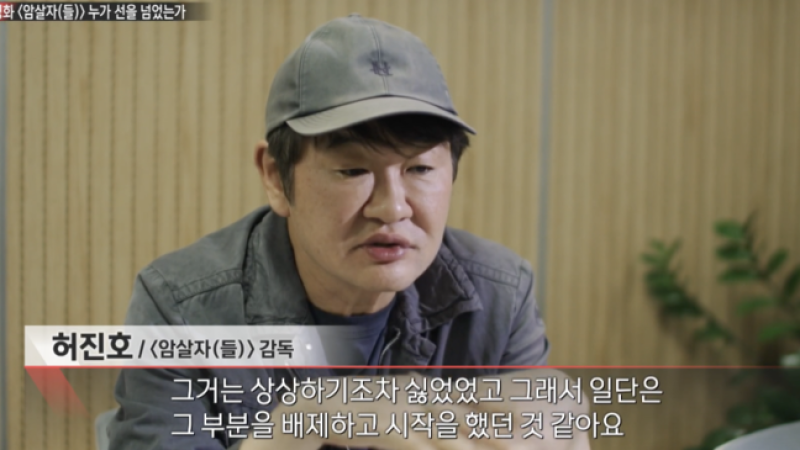
Director Heo Jin-ho has broken nearly a month of public silence over the historical interpretation controversy surrounding his film ‘Assassins,’ telling MBC’s current affairs program ‘PD Notebook’ that raising questions about the official account of a historical event is itself a legitimate subject for cinema. The episode, titled “The Assassins: Who Crossed the Line?” aired on October 27, and marked the director’s first on-camera response since the film opened on September 23.
Heo began by recalling his own memory of the incident at the heart of the film. He said he was in the fifth grade of elementary school when First Lady Yuk Young-soo died, and that his parents, his sisters and he himself were deeply saddened. The shooting took place on August 15, 1974, at the National Theater in Seoul’s Jangchung-dong, during an event attended by then President Park Chung-hee, who survived the attack while his wife was fatally shot.
The director said his view of the case changed after watching documentaries in 2005, naming MBC’s ‘Now It Can Be Told’ and SBS’s ‘Unanswered Questions.’ He said the gap between the investigation findings announced in 1974 and the material presented in 2005 was very large, and that the discrepancy struck him as compelling material for a film. He stressed that the documentaries featured interviews with people connected to the case, including security officers, a forensics chief and a person involved in letting the gunman into the venue.
“There were new details raised in 2005, and major media outlets and historians also raised questions about them,” Heo said, according to OSEN’s account of the broadcast. “I made the film with those questions, and I maximized the questions.” He added that he could not accept criticism framed as asking why he did not simply follow the 1974 findings or why he raised doubts about them. The film itself carries a caption stating that it is based on a true story while its characters and specific events are adapted from imagination, a point Heo’s defenders have cited in the debate.
The controversy has gone well beyond film criticism since the release. Protests by some conservative groups were held outside the home of lead actor Yoo Hae-jin, and complaints were directed at companies that hired cast members as advertising models. During a National Assembly audit, the need for a search and seizure related to the film was even raised. In addition, 109 lawmakers from the People Power Party sent a letter to the 37th Singapore International Film Festival asking it to withdraw ‘Assassins’ as its opening film, a request the festival declined when it confirmed the selection on October 7. The film went on to open the festival on October 21, where Heo said he felt honored by the selection.
The fallout has also reached the festival circuit at home. At the Busan International Film Festival, which opened on October 16, the ‘Assassins’ team did not appear in public, and audience talks and fan events were cancelled. Film critic Jeon Chan-il expressed regret at their absence, while director Lee Myung-se said he was appalled after four decades of making films to see protests staged outside an actor’s home, warning that such a climate could intimidate creators and drive investment away.
Not everyone in the debate accepts the director’s framing. Sungkyunkwan University sociology professor Koo Jung-woo cautioned on the program that audiences may find it difficult to clearly distinguish fact from fiction in a film built around a historical event. That concern sits at the center of the dispute: critics argue the film’s interpretation distorts a national tragedy, while Heo and his supporters argue that questioning an official account is a matter of creative freedom, not distortion.
The production team has previously said that various interpretations and criticism are possible given that the film deals with a historical case involving real people, which it respects, but that the film was not made for a specific political purpose. ‘Assassins’ follows a detective, a reporter and a newspaper editor investigating inconsistencies in the official account of the 1974 shooting, and it has drawn more than 3.34 million admissions despite the controversy, a sign that the debate has not kept audiences away entirely.
Whether Heo’s first public statement calms the dispute or fuels it further remains to be seen. The director’s appearance framed the argument as one about the boundary between legitimate criticism and pressure on creators, and that framing is now the question facing the film’s critics, its defenders and the audiences still deciding what to make of ‘Assassins.’