EJAE, the singer-songwriter behind the global hit “Golden” from Netflix’s “KPop Demon Hunters,” has received the Prime Minister’s Commendation at the 17th Korea Popular Culture and Arts Awards, adding a Korean government honor to a year of international awards.
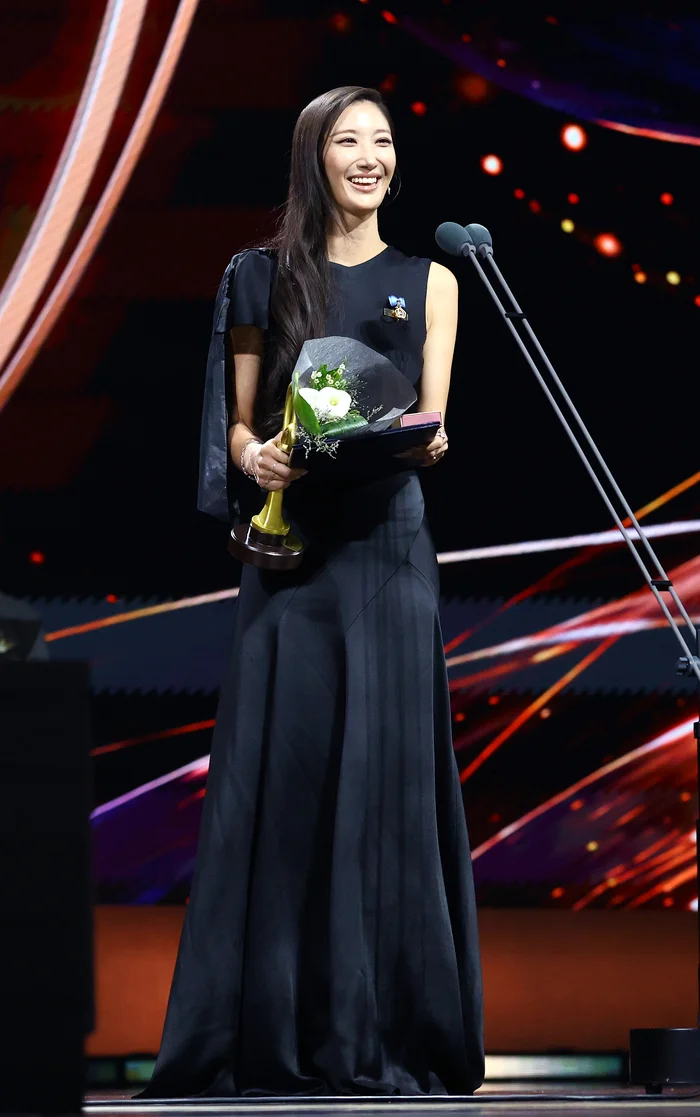
The singer accepted the commendation on October 29 at the Haeoreum Grand Theater of the National Theater of Korea in Jung-gu, Seoul. According to Sports Seoul, EJAE took the stage in a black dress and told the audience she was truly honored to receive what she described as a deeply meaningful award.
“Above all, I want to say thank you to Korea,” she said, adding that the honor carried extra weight because it was the first award she had received in Korea. “This award is even more special and precious because it is the first award I have received in Korea,” she said.
EJAE described Korea as the place where she first began to dream of a life in music as a singer and songwriter. She said she learned there the value of hard work and of not giving up in difficult moments, lessons she said she carried with her as she continued working in the United States.
“Korea gave me the dream of music and precious lessons,” she said, closing her remarks by promising to repay that support with good music. Sports Seoul reported that her remarks drew attention for their sincerity, coming from an artist reflecting on her beginnings at the height of a global breakthrough.
EJAE sang the role of Rumi, the leader of the fictional girl group HUNTR/X, in “KPop Demon Hunters,” and she also worked as a co-composer on “Golden,” the film’s signature song. Sports Seoul reported that “Golden” won song awards at the 2026 Academy Awards and Golden Globe Awards, and took the Grammy Award for Best Song Written for Visual Media. English-language coverage of the government awards separately noted that “Golden” topped the Billboard Hot 100.
The Korea Popular Culture and Arts Awards are the South Korean government’s highest honors for popular culture and the arts, established in 2010 to recognize artists and professionals who have helped develop the industry. This year’s ceremony honored 36 individuals and teams in total: 10 recipients of Orders of Cultural Merit, seven Presidential Commendations, eight Prime Minister’s Commendations, and 11 Minister of Culture, Sports and Tourism Commendations.
EJAE shared the Prime Minister’s Commendation tier with broadcaster Bae Mi-hyang, actors Yoo Seung-mok, Kim Go-eun, and Oh Jung-se, director Yoon Ga-eun, pansori singer and musical actor Lee Ja-ram, and sibling duo AKMU. The ceremony’s top cultural medals went to the late rock icon Shin Hae-chul and, on the 10th anniversary of their debut, all four members of BLACKPINK.
For EJAE, the Seoul honor closes a circle that began long before “KPop Demon Hunters.” After years as a trainee and years of musical challenges, she has now been recognized both abroad, through the film’s awards-season run, and at home, where her career first took shape. Attention now turns to what she does next as both a vocalist and a songwriter on the world stage.
The commendation also reflects how thoroughly “KPop Demon Hunters” has crossed over from streaming hit to cultural talking point. English-language coverage of the awards announcement described EJAE as the composer who took “Golden” to No. 1 on the Billboard Hot 100 and to a Grammy win, a trajectory that has made her one of the most visible Korean creative voices in global popular music this year, even though she performs behind an animated character rather than under her own name on stage.
That distance between the performer and the persona is part of what made her acceptance speech stand out. Rather than dwelling on chart positions or trophies, EJAE used her moment at the National Theater to talk about beginnings: the years of training, the challenges of sustaining a music career, and the country where she first learned to persist. It was a reminder that the global success story had a local starting point, and that the government honor was, in her telling, recognition from the place where it all began.
No further announcements about EJAE’s next project were included in the awards coverage. For now, the commendation stands as a formal acknowledgment from Korea’s cultural establishment that the voice behind one of the year’s defining songs is, in the words of her own acceptance speech, a product of the country where she first learned to keep going.